Why Dahlia Tuber Size Doesn’t Matter as Much as You Think
If you’ve ever opened a much anticipated parcel of dahlia tubers and immediately judged them by size, you’re not alone.
It’s easy to assume a bigger tuber must be better. Bigger plant, bigger flowers, better result, right?
Except dahlias don’t really work like that.
A large tuber can absolutely grow beautifully. But a smaller tuber can also grow beautifully. Often in my experience, the smaller ones are the ones that establish quickly, grow strongly and go on to produce excellent tuber clumps by the end of the season.
So if size isn’t the main thing, what actually matters?
Viability!
A dahlia tuber doesn’t need to be huge. It needs to have the right parts, come from healthy stock and be handled properly before it reaches you.

Dahlia tuber anatomy: what actually matters
A viable dahlia tuber needs a few key parts:
- crown
- eye
- neck
- body
The body is the swollen part of the tuber. It stores energy for the plant and is the part most people notice first.
The neck connects the body to the crown. If the neck is broken, the tuber is no longer connected to the growing point.
The crown is the top section where the tuber attaches back to the main stem or clump.
The eye is the growing point. This is what produces the new shoot.
To grow successfully, a tuber needs the right structure. A big, chunky body on its own won’t grow if it doesn’t have a viable eye and crown. A smaller tuber with a good neck, body, crown and eye can grow perfectly well.
This is why judging a dahlia tuber by size alone is misleading.
Bigger can be fine. Smaller can be fine. Missing the important bits is the problem.

You can’t always see the eyes
One of the tricky things with dahlias is that eyes aren’t always obvious.
Sometimes they’re clear little bumps on the crown. Sometimes they’re only just starting to show. Sometimes they’re still dormant and difficult to see.
That’s why the way a tuber is divided matters.
When I divide dahlia tubers, I’m looking at the whole structure. I want to see a healthy body, an intact neck and a piece of crown where an eye is either visible or likely to emerge.
A tuber doesn’t have to look picture-perfect to be viable, it just needs the right anatomy.

Different varieties produce different tubers
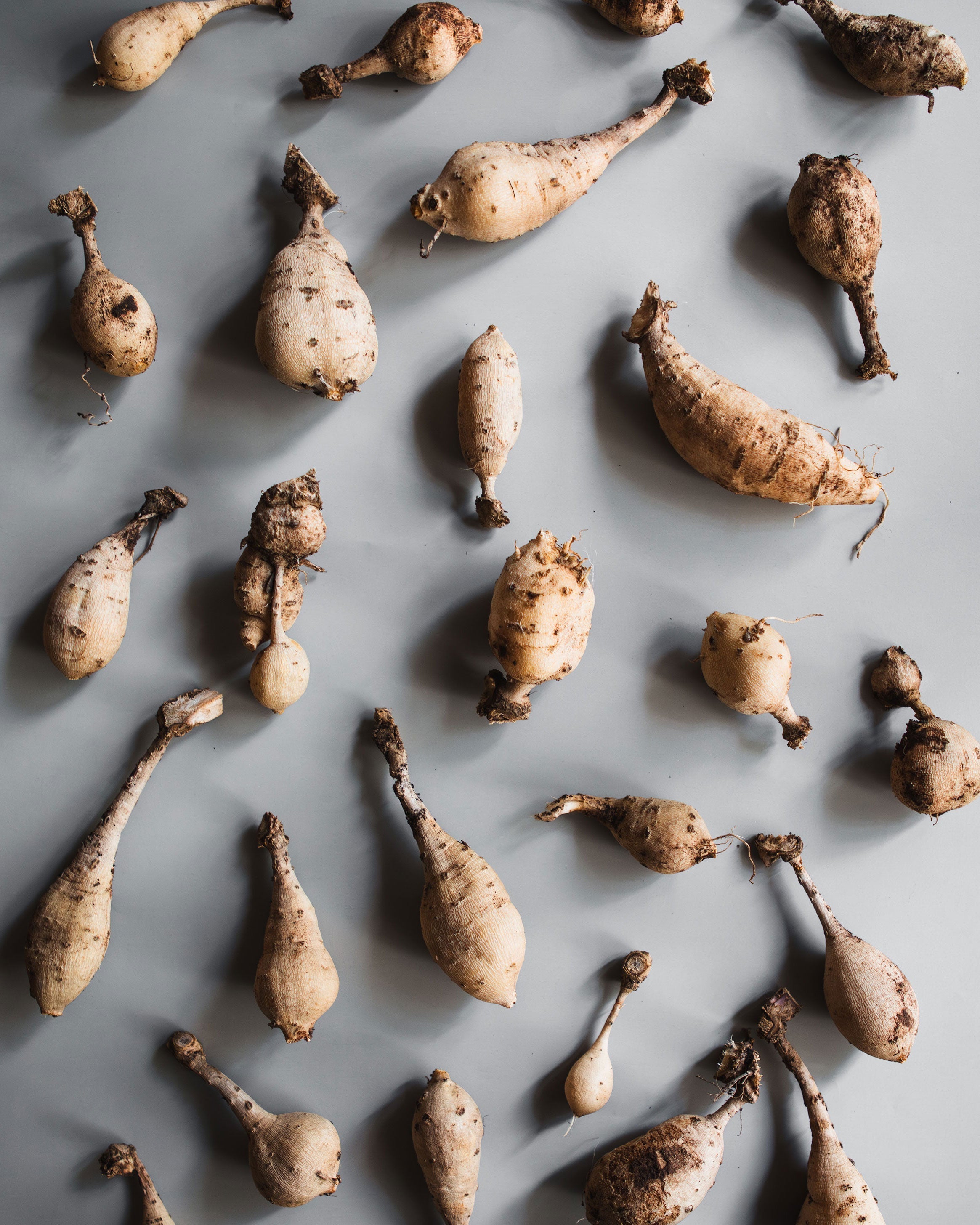
Dahlia tubers vary wildly between cultivars.
Some varieties produce big, chunky tubers that look like sweet potatoes. Larger decorative dahlias often fall into this camp. They can produce hefty tubers that look impressive straight away.
Other varieties make much smaller, fiddlier tubers. Mini poms, for example, can produce the most annoying little tuber balls imaginable. They’re often tight, awkward and a nightmare to divide cleanly.
Then there’s everything in between, because nature is just out there doing whatever she likes.
This variation is normal.
A smaller tuber from one variety might be completely standard for that cultivar. A larger tuber from another variety might also be normal. You can’t expect every dahlia tuber to look the same because the plants don’t grow the same underground.
Tuber size can also be affected by the season, soil, growing time, plant health, lifting time and how the clump formed.
So yes, there can be wild variation. That doesn’t automatically mean there’s a problem.

Why I don’t mind smaller tubers
Anecdotally, I actually prefer smaller tubers in a lot of cases.
I find they’re easier to plant, easier to handle and often establish really well. In my own growing conditions, smaller viable tubers can go on to produce excellent clumps by the end of the season.
My theory is that they aren’t relying quite so heavily on a large store of energy from the original tuber. They seem to get on with forming a strong root system and building new tubers of their own.
That’s not a scientific claim. It’s just what I’ve seen here in the field over years of growing, lifting and dividing dahlias.
The main point is this: small doesn’t mean weak or poor quality.
A small tuber with the right anatomy can be a very good tuber!

Bigger isn’t always better
Large tubers can look reassuring, but they’re not automatically better.
A big tuber with no viable eye won’t grow.
A big tuber with a snapped neck won’t grow.
A big tuber with rot or damage may not store well.
Meanwhile, a smaller tuber with a sound neck, body, crown and eye can produce a healthy plant.
This is why I care more about viability than size.
The question isn’t “is this tuber big?”, the question is “does this tuber have what it needs to grow?”
Health matters too
Size isn’t the only thing I’m looking at when I decide what to keep, replant or release.
I also want tubers to come from plants that have been grown with care and monitored through the season.
At Thistle & Weeds, I cull for virus and remove anything that raises concern in the field. That helps minimise risk and keeps the stock as clean as possible.
A quick caveat: no grower can completely rule out virus. Dahlia viruses can sit dormant and only show under stress, so it’s not something anyone can honestly guarantee with absolute certainty.
That’s a bigger topic for another day...
But it does matter that your tubers come from a grower who is actively watching for issues, culling suspicious plants and not knowingly sending out problem stock.

What I will and won’t send
I won’t send you a tuber just because it is technically viable.
Every tuber is checked before release. I’m looking for viability, health and structure. I want to be confident it has what it needs to grow well for you.
That doesn’t mean every tuber will be large, smooth or perfectly shaped. Dahlia tubers are living plant material. Some are chunky. Some are slim. Some are a little odd-looking. Some varieties are naturally awkward.
But there’s a difference between natural variation and a tuber I don’t feel good about sending.
I won’t send anything I wouldn’t be happy to receive myself. Once bitten, twice shy. I know full well how it feels to pay good money and receive a shrivelled little pebble that looks like it was gathering dust in the back of the shed for several years.
The ugly ducklings, the questionable ones and the tubers I’m less confident in stay here. If they’re worth trialling, I’ll replant them on the farm and see how they perform. They don’t go out in orders.

The main thing to remember
Dahlia tuber size doesn’t matter as much as people think.
What matters is that the tuber is viable, healthy and has the right structure to grow.
A good dahlia tuber needs:
- a body
- a neck
- a crown
- an eye or likely growing point
Some tubers will be big. Some will be small. Some will be neat. Some will be strange. Different varieties produce different tubers and there will always be variation.
That’s normal.
So don’t panic if a tuber isn’t huge. If it has what it needs to grow, it can still produce a beautiful plant and a strong clump by the end of the season.
Bigger isn’t the goal. Viable is.
Sam x
Planning your dahlia patch?
Our dahlia tubers are grown in the Dandenong Ranges, Victoria, then lifted, divided and checked by hand before release.
If you’d like first access when our next dahlia tuber pre-sale opens, join the Dahlia Tuber Waitlist.
Join the Dahlia Tuber Waitlist
You can also browse the dahlia tuber collection to see the varieties planned for release.
Want more dahlia growing notes?
I’ve pulled together a Dahlia Growing Resources page with practical guides on choosing, growing, digging, dividing and storing dahlias.
It’s a good place to start if you’re building your wishlist, planning your patch or trying to work out what to do with your tubers at the end of the season.
Explore the Dahlia Growing Resources